ℹ️ What will you do and learn in this chapter?
- What feature flags are
- Why OpenFeature matters
- The OpenFeature basics: Evaluation API, Provider, Context
- How to get more details from the Evaluation API
- Using the Flagd provider
Getting started with OpenFeature & Feature Flagging
What is Feature Flagging?
Feature flagging is a software development technique that allows teams to enable, disable, or modify features in an application at runtime without deploying new code.
By wrapping code in conditionals linked to a feature management system, you can decouple deployment (shipping the code to a server or device) from release (making the feature available to users). This brings several key benefits:
- Trunk-Based Development: Developers can safely merge incomplete features into the main branch by hiding them behind a flag.
- Risk Mitigation: If a new feature causes bugs or performance issues, it can be instantly disabled (a "kill switch") without requiring a stressful rollback or hotfix deployment.
- Canary Releases & Progressive Delivery: Roll out features gradually (e.g., 10% of users, then 50%, then 100%) to monitor impact.
- A/B Testing: Serve different variations of a feature to different segments of users to see which performs better.
- Targeting: Enable features only for specific users, such as internal testers, beta users, or premium subscribers.
Feature Flagging vs. Feature Flipping: What's the difference?
While often used interchangeably, Feature Flipping (or Feature Toggles) is typically viewed as a more basic subset of feature flagging.
- Feature Flipping generally refers to simple binary switches (
ON/OFF) often managed via static configuration files or simple database tables. They act as blunt instruments to enable or disable large blocks of functionality for everyone. - Feature Flagging, on the other hand, implies a more robust, dynamic system capable of complex evaluation logic. It involves contextual routing (e.g., "Is this user a premium member in the EU region?") and dynamic updates in real-time without restarting the application. Feature flagging platforms provide dashboards, audit logs, and integrations to manage the lifecycle of these flags at scale.
Why OpenFeature?
OpenFeature is an open specification sponsored by the CNCF that provides a vendor-agnostic, community-driven API for feature flagging that works with your favorite feature flag management tool or in-house solution.
In the past, integrating feature flags meant coupling your application to a specific vendor's SDK. If you wanted to switch vendors, or even use a mix of in-house and third-party tools, you'd have to rewrite all your feature flag evaluations.
OpenFeature solves this by separating the evaluation API from the flag management system.
It achieves this through a flexible architecture with three main components:
- The Evaluation API: The vendor-agnostic interface developers use in their application code to evaluate flags (e.g.,
client.getBooleanValue("my-flag", false)). - The Provider: The translation layer between the OpenFeature API and the specific feature flagging backend (like LaunchDarkly, Split, Flagd, or even a simple in-memory map).
- The Evaluation Context: A mechanism to provide contextual information (like user IDs, tenant IDs, or request metadata) during flag evaluation to enable dynamic targeting rules.
Here is a diagram illustrating the flow from the Evaluation API down to the Provider:
By standardizing feature flagging, OpenFeature enables:
- Vendor lock-in prevention: Switch providers by changing a single line of configuration.
- Consistency: Use the same API across different languages and frameworks.
- Extensibility: Add common behaviors like logging, caching, or telemetry via Hooks.
What brings OpenFeature on top of Feature-Flagging?
Without OpenFeature:
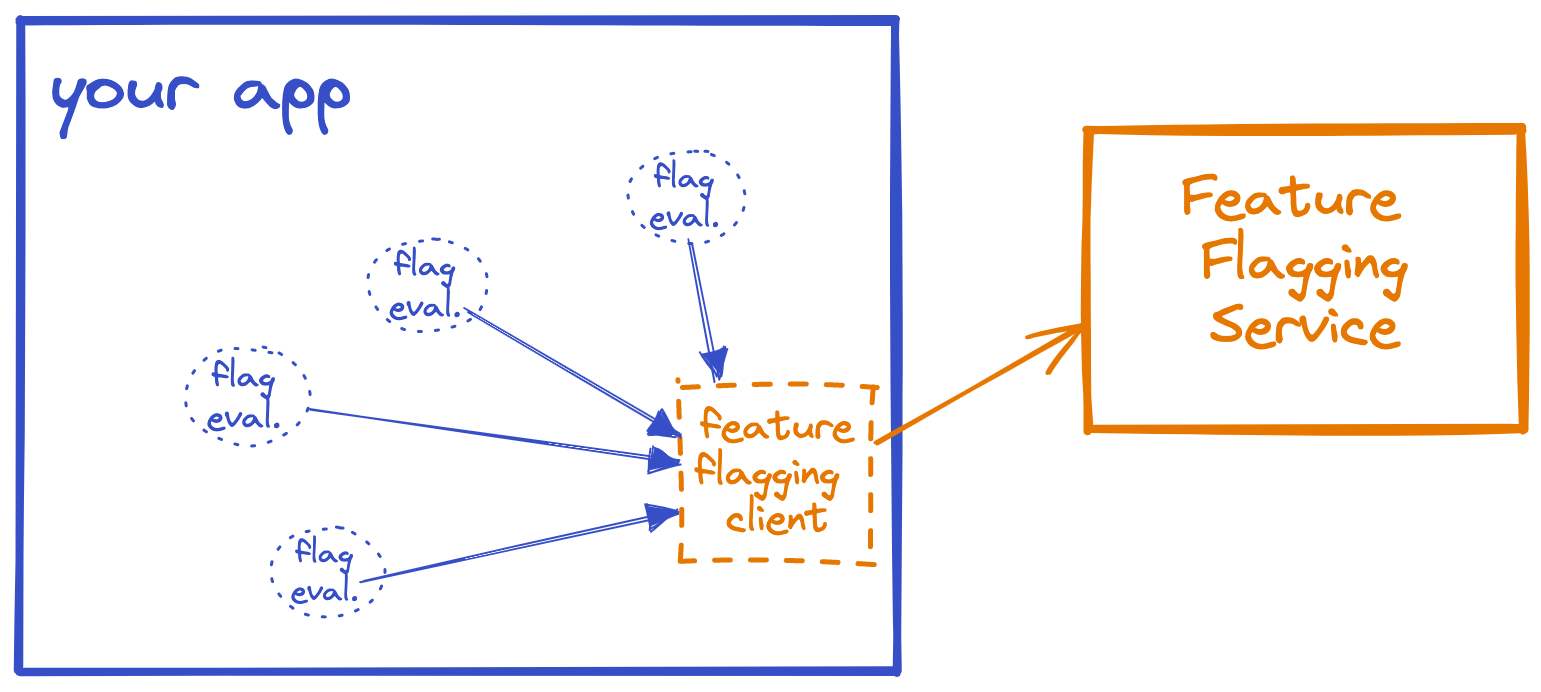
With OpenFeature, we get a standardized API decoupling the feature flag repository from the clients:
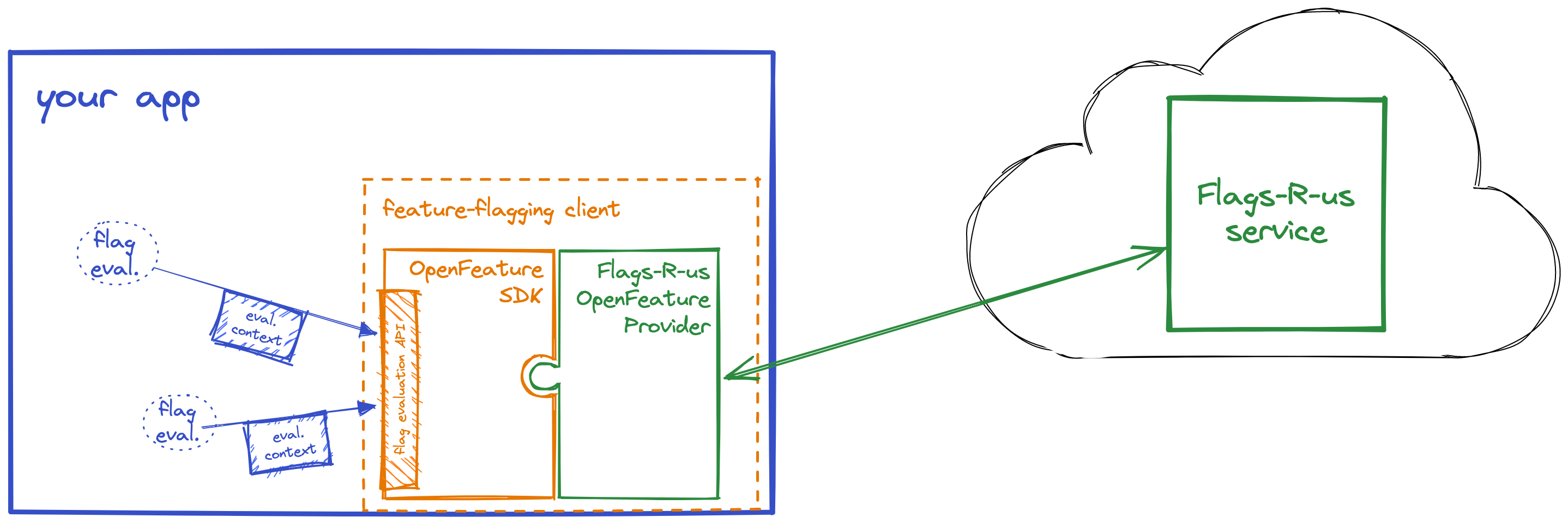
🔗 Learn more: OpenFeature Architecture & Concepts
The Evaluation API
Let's dig into the Evaluation API. For this first try, we will update the DiscountAdapter class to use OpenFeature.
First, enable the OpenFeature libraries in your classpath in the pom.xml file.
📝 Uncomment this section:
<dependency>
    <groupId>dev.openfeature</groupId>
    <artifactId>sdk</artifactId>
    <version>1.20.1</version>
</dependency>
<dependency>
    <groupId>dev.openfeature.contrib.providers</groupId>
    <artifactId>flagd</artifactId>
    <version>0.11.20</version>
</dependency>
🛠️ Run the following command in a console:
cd api
./mvnw compile
🛠️ Refresh your editor.
📝 Go to the DiscountAdapter class.
🛠️ Add a new attribute to get the OpenFeatureAPI instance and update the constructor as follows:
private final OpenFeatureAPI openFeatureAPI;

public DiscountAdapter(OpenFeatureAPI openFeatureAPI) {
    this.openFeatureAPI = openFeatureAPI;
}
ℹ️ This way, the OpenFeatureAPI is automatically provided by CDI.
📝 Update the import declaration as well:
import dev.openfeature.sdk.OpenFeatureAPI;
📝 Then, comment out the existing code and add the new one using OpenFeature:
    @Override
    public Result<Instrument> applyDiscount(Instrument instrument, User user) {
        // For now, let's keep it simple (manually toggle for testing if needed)
//        boolean manualDiscount = false; // Toggle to true to test UI
//        if (manualDiscount) {
//            double originalPrice = instrument.price();
//            double discountedPrice = originalPrice * 0.9; // 10% discount
//            return Result.success(instrument.withDiscount(discountedPrice, originalPrice));
//        }
        boolean isDiscountEnabled = this.openFeatureAPI.getClient().getBooleanValue("discount-enabled", false);
        if (isDiscountEnabled) {
            double originalPrice = instrument.price();
            double discountedPrice = originalPrice * 0.9; // 10% discount
            return Result.success(instrument.withDiscount(discountedPrice, originalPrice));
        }
        return Result.success(instrument);
    }
👀 Look into the methods provided by the Client class.
At the end, you should get this class:
package info.touret.musicstore.infrastructure.featureflag.adapter;

import dev.openfeature.sdk.OpenFeatureAPI;
import info.touret.musicstore.domain.model.Instrument;
import info.touret.musicstore.domain.model.Result;
import info.touret.musicstore.domain.model.User;
import info.touret.musicstore.domain.port.DiscountPort;
import jakarta.enterprise.context.ApplicationScoped;
import org.slf4j.Logger;
import org.slf4j.LoggerFactory;

@ApplicationScoped
public class DiscountAdapter implements DiscountPort {
    private static final Logger LOGGER = LoggerFactory.getLogger(DiscountAdapter.class);
    private final OpenFeatureAPI openFeatureAPI;

    public DiscountAdapter(OpenFeatureAPI openFeatureAPI) {
        this.openFeatureAPI = openFeatureAPI;
    }

    @Override
    public Result<Instrument> applyDiscount(Instrument instrument, User user) {
        // TODO: Chapter 3 - Implement this with OpenFeature
        // For now, let's keep it simple (manually toggle for testing if needed)
//        boolean manualDiscount = false; // Toggle to true to test UI
//        if (manualDiscount) {
//            double originalPrice = instrument.price();
//            double discountedPrice = originalPrice * 0.9; // 10% discount
//            return Result.success(instrument.withDiscount(discountedPrice, originalPrice));
//        }
        boolean isDiscountEnabled = this.openFeatureAPI.getClient().getBooleanValue("discount-enabled", false);
        if (isDiscountEnabled) {
            double originalPrice = instrument.price();
            double discountedPrice = originalPrice * 0.9; // 10% discount
            return Result.success(instrument.withDiscount(discountedPrice, originalPrice));
        }
        return Result.success(instrument);
    }
}
ℹ️ At this point, your code won't work at all because we haven't declared the factory and the provider yet.
In-Memory Provider
First Implementation
ℹ️ For our first try with OpenFeature, we will use the simplest provider: the InMemoryProvider. It is only available for testing purposes.
🛠️ Create the class src/main/java/info/touret/musicstore/infrastructure/featureflag/openfeature/OpenFeatureFactory.java with the following content:
package info.touret.musicstore.infrastructure.featureflag.openfeature;

import dev.openfeature.sdk.FeatureProvider;
import dev.openfeature.sdk.OpenFeatureAPI;
import dev.openfeature.sdk.providers.memory.Flag;
import dev.openfeature.sdk.providers.memory.InMemoryProvider;
import io.quarkus.arc.Arc;
import jakarta.annotation.PreDestroy;
import jakarta.enterprise.context.ApplicationScoped;
import jakarta.ws.rs.Produces;
import org.slf4j.Logger;
import org.slf4j.LoggerFactory;

import java.util.Map;

/**
 * OpenFeature Factory Class
 */
@ApplicationScoped
public class OpenFeatureFactory {

    private static final Logger LOGGER = LoggerFactory.getLogger(OpenFeatureFactory.class);

    /**
     * Creates the provider
     * @return The {@link FeatureProvider} instance
     * @see dev.openfeature.sdk.providers.memory.InMemoryProvider
     */
    private FeatureProvider createProvider() {
        Map<String, Flag<?>> flags = Map.of(
                // Creates a flag to enable discounts
                "discount-enabled", Flag.builder()
                        .variant("on", true)
                        .variant("off", false)
                        .defaultVariant("on")
                        .build(),
                // Creates a flag to show the welcome message
                "welcome-message", Flag.builder()
                        .variant("greeting", "Bienvenue sur notre boutique !")
                        .variant("empty", "")
                        .defaultVariant("greeting")
                        .build()
        );
        return new InMemoryProvider(flags);
    }

    /**
     * Creates the {@link OpenFeatureAPI} instance
     * @return The {@link OpenFeatureAPI} instance
     */
    @ApplicationScoped
    @Produces
    public OpenFeatureAPI getOpenFeatureAPIInstance() {
        var openFeatureAPI = OpenFeatureAPI.getInstance();
        openFeatureAPI.setProvider(createProvider());
        return openFeatureAPI;
    }

    /**
     * Destroys the OpenFeature instance and flushes pending events
     */
    @PreDestroy
    private void shutdownProvider() {
        try {
            var openFeatureAPI = Arc.container().select(OpenFeatureAPI.class).get();
            if (openFeatureAPI != null) {
                openFeatureAPI.shutdown();
            }
        } catch (Exception e) {
            LOGGER.warn("Failing to shutdown the provider");
        }
    }
}
📝 Go to the DiscountAdapterTest class and update the integration test.
From:
@Test
void should_return_the_instrument_with_no_discount_successfully() {
    assertEquals(instrument.price(), discountAdapter.applyDiscount(instrument, user).value().price());
}
To:
@Test
void should_return_the_instrument_with_a_discount_successfully() {
    assertEquals(instrument.price() * 0.9, discountAdapter.applyDiscount(instrument, user).value().price());
}
🛠️ Restart your Quarkus Dev environment by typing Ctrl+C in your console and restarting the command:
./mvnw quarkus:dev
✅ Validate your unit/integration tests by typing r to resume testing.
👀 You should see this output in your console:
--
All 56 tests are passing (0 skipped), 56 tests were run in 11808ms. Tests completed at 07:48:01.
🛠️ You can also run this API call with the httpie tool in another terminal:
http :8080/instruments User:'{"firstName":"john","lastName":"Doe","email":"john.doe@gmail.com","country":"FR"}' accept:"application/json"
👀 You should see the same content as before:
{
   "description": "MIDI Controller / Sequencer",
   "hasDiscount": true,
   "id": 100,
   "manufacturer": "Arturia",
   "name": "KeyStep Pro",
   "originalPrice": 450.0,
   "price": 405.0,
   "reference": "ART-KEY-01",
   "type": "PIANO"
}
Getting More Details
ℹ️ OpenFeature also brings an API to get more details about the evaluation. We will see how it matters to make it fully observable in the Observability Chapter.
Let's see how to put it in place:
📝 Update the code located in the method applyDiscount of the DiscountAdapter class:
From:
boolean isDiscountEnabled = this.openFeatureAPI.getClient().getBooleanValue("discount-enabled", false);
To:
var evaluationDetails = this.openFeatureAPI.getClient().getBooleanDetails("discount-enabled", false);
LOGGER.info(evaluationDetails.toString());
boolean isDiscountEnabled = evaluationDetails.getValue();
Run the same API call again:
http :8080/instruments User:'{"firstName":"john","lastName":"Doe","email":"john.doe@gmail.com","country":"FR"}' accept:"application/json"
👀 The logger will help us see what is provided through the details:
2026-04-13 19:32:23,833 INFO [info.touret.musicstore.infrastructure.featureflag.adapter.DiscountAdapter] (main) FlagEvaluationDetails(flagKey=discount-enabled, value=true, variant=on, reason=STATIC, errorCode=null, errorMessage=null, flagMetadata=dev.openfeature.sdk.ImmutableMetadata@3b)
📝 Next, change the flag key to wrong-discount-enabled:
var evaluationDetails = this.openFeatureAPI.getClient().getBooleanDetails("wrong-discount-enabled", false);
LOGGER.info(evaluationDetails.toString());
boolean isDiscountEnabled = evaluationDetails.getValue();
👀 You should see output like this in the console:
 mapstruct.suppressGeneratorVersionInfoComment, mapstruct.defaultComponentModel, mapstruct.suppressGeneratorTimestamp]', line -1 in [unknown source]
2026-04-14 07:50:12,773 INFO  [io.quarkus.hibernate.orm.deployment.dev.HibernateOrmDevServicesProcessor] (build-15) Setting quarkus.hibernate-orm.schema-management.strategy=drop-and-create to initialize Dev Services managed database
2026-04-14 07:50:14,035 INFO  [io.quarkus.arc.processor.BeanProcessor] (build-5) Found unrecommended usage of private members (use package-private instead) in application beans:
        - @PreDestroy callback info.touret.musicstore.infrastructure.featureflag.openfeature.OpenFeatureFactory#shutdownProvider()
2026-04-14 07:50:15,418 ERROR [io.quarkus.test] (Test runner thread) ==================== TEST REPORT #2 ====================
2026-04-14 07:50:15,418 ERROR [io.quarkus.test] (Test runner thread) Test DiscountAdapterTest#should_return_the_instrument_with_a_discount_successfully() failed
: org.opentest4j.AssertionFailedError: expected: <4050.0> but was: <4500.0>
        at org.junit.jupiter.api.AssertionFailureBuilder.build(AssertionFailureBuilder.java:158)
        at org.junit.jupiter.api.AssertionFailureBuilder.buildAndThrow(AssertionFailureBuilder.java:139)
        at org.junit.jupiter.api.AssertEquals.failNotEqual(AssertEquals.java:201)
        at org.junit.jupiter.api.AssertEquals.assertEquals(AssertEquals.java:184)
        at org.junit.jupiter.api.AssertEquals.assertEquals(AssertEquals.java:179)
        at org.junit.jupiter.api.Assertions.assertEquals(Assertions.java:933)
        at info.touret.musicstore.infrastructure.featureflag.adapter.DiscountAdapterTest.should_return_the_instrument_with_a_discount_successfully(DiscountAdapterTest.java:28)


2026-04-14 07:50:15,420 ERROR [io.quarkus.test] (Test runner thread) >>>>>>>>>>>>>>>>>>>> Summary: <<<<<<<<<<<<<<<<<<<<
info.touret.musicstore.infrastructure.featureflag.adapter.DiscountAdapterTest#should_return_the_instrument_with_a_discount_successfully(DiscountAdapterTest.java:28) DiscountAdapterTest#should_return_the_instrument_with_a_discount_successfully() expected: <4050.0> but was: <4500.0>
2026-04-14 07:50:15,421 ERROR [io.quarkus.test] (Test runner thread) >>>>>>>>>>>>>>>>>>>> 1 TEST FAILED <<<<<<<<<<<<<<<<<<<<
ℹ️ It means the flag key wasn't found, and the default value was taken into account.
🛠️ If you call the API again using this command:
http :8080/instruments User:'{"firstName":"john","lastName":"Doe","email":"john.doe@gmail.com","country":"FR"}' accept:"application/json"
👀 You will see the details of the feature flag value resolution:
2026-04-14 07:53:13,694 INFO  [info.touret.musicstore.infrastructure.featureflag.adapter.DiscountAdapter] (quarkus-virtual-thread-0) FlagEvaluationDetails(flagKey=wrong-discount-enabled, value=false, variant=null, reason=ERROR, errorCode=FLAG_NOT_FOUND, errorMessage=flag wrong-discount-enabled not found, flagMetadata=dev.openfeature.sdk.ImmutableMetadata@3b)
2026-04-14 07:53:13,694 DEBUG [info.touret.musicstore.domain.service.InstrumentService] (quarkus-virtual-thread-0) Applying discount to instrument [Instrument{id=100, name='KeyStep Pro', reference='ART-KEY-01', manufacturer='Arturia', price=450.0, description='MIDI Controller / Sequencer', type=PIANO}] for user [User{firstname='null', lastname='null', email='john.doe@gmail.com', country='FR'}]
📝 Finally, restore the correct flag key to discount-enabled:
var evaluationDetails = this.openFeatureAPI.getClient().getBooleanDetails("discount-enabled", false);
LOGGER.info(evaluationDetails.toString());
boolean isDiscountEnabled = evaluationDetails.getValue();
Flagd
ℹ️ OpenFeature provides many SDKs to interact with different feature flag providers.
We will now improve our application by moving from our in-memory provider to Flagd.
It provides different ways to retrieve and resolve flags:
- Through an RPC server
- Through an internally managed process
- From a file
During this workshop, we will use the offline mode with a configuration file.
📝 Go to the OpenFeatureFactory class and update the createProvider() method as shown below:
From:
private FeatureProvider createProvider() {
    Map<String, Flag<?>> flags = Map.of(
            // Creates a flag to enable discounts
            "discount-enabled", Flag.builder()
                    .variant("on", true)
                    .variant("off", false)
                    .defaultVariant("on")
                    .build(),
            // Creates a flag to show the welcome message
            "welcome-message", Flag.builder()
                    .variant("greeting", "Bienvenue sur notre boutique !")
                    .variant("empty", "")
                    .defaultVariant("greeting")
                    .build()
    );
    return new InMemoryProvider(flags);
}
To:
private FeatureProvider createProvider() {
    return new FlagdProvider(
            FlagdOptions.builder()
                    .resolverType(Config.Resolver.FILE)
                    .offlineFlagSourcePath(Thread.currentThread().getContextClassLoader().getResource("/flags.flagd.json").getPath())
                    .build());
}
Add then the following import declarations:
import dev.openfeature.contrib.providers.flagd.Config;
import dev.openfeature.contrib.providers.flagd.FlagdOptions;
import dev.openfeature.contrib.providers.flagd.FlagdProvider;
ℹ️ This setup relies on a file located at src/main/resources/flags.flagd.json.
🛠️ Create it and push the corresponding former rules to this file as follows:
{
  "flags": {
    "welcome-message": {
      "variants": {
        "on": true,
        "off": false
      },
      "state": "ENABLED",
      "defaultVariant": "on"
    },
    "discount-enabled": {
      "variants": {
        "on": true,
        "off": false
      },
      "state": "ENABLED",
      "defaultVariant": "on"
    }
  }
}
🛠️ Save it and restart the integration tests.
👀 You can either type 'r' in the Quarkus Dev environment and get the following output:
--
All 56 tests are passing (0 skipped), 56 tests were run in 1931ms. Tests completed at 16:51:58.
ℹ️ If it doesn't work, feel free to restart it.
🛠️ You can also run the following command:
./mvnw clean verify
Evaluation Context
ℹ️ Beyond just a static true/false flag, OpenFeature provides the ability to evaluate a flag with different parameters. These parameters may be global (e.g., the application's version) to the application or dependent on current transactions.
For instance, we may set a global static parameter that enables a feature for all users, and a client parameter to enable a feature taking into account a session parameter such as the country of the current user.
ℹ️ If you want more information, feel free to check out the official documentation.
We will now enable the discount for users located in France.
📝 Go to the DiscountAdapter class and update the method applyDiscount() as follows:
From:
var evaluationDetails = this.openFeatureAPI.getClient().getBooleanDetails("discount-enabled", false);
To:
var openFeatureAPIClient = this.openFeatureAPI.getClient();
openFeatureAPIClient.setEvaluationContext(new MutableContext().add("clientCountry", user.country()));
var evaluationDetails = openFeatureAPIClient.getBooleanDetails("discount-enabled", false);
📝 Then go to the src/main/resources/flags.flagd.json file and update the discount-enabled flag with the following content:
"discount-enabled": {
  "variants": {
    "on": true,
    "off": false
  },
  "state": "ENABLED",
  "defaultVariant": "off",
  "targeting": {
    "if": [
      {
        "==": [
          {
            "var": "clientCountry"
          },
          "FRANCE"
        ]
      },
      "on",
      null
    ]
  }
}
ℹ️ Short Explanation
- The Flagd targeting model evaluates the feature flag against the context broadcasted through the
MutableContextclass. - Here, the
discount-enabledflag is only enabled if the targeting criteria (i.e.,clientCountry) is equal toFRANCE. - The targeting structure is based on JsonLogic. Below is the
ifclause syntax:
"if": [
  condition,   // If this condition is true (clientCountry == FRANCE)
  then,        // Then return this variant ("on")
  else         // Else, return this value (null)
]
When the targeting rule returns null, Flagd ignores the rule and automatically returns the default variant (i.e., off).
ℹ️ Normally at this point, your integration tests keep working.
Let's update the DiscountAdapterTest class with an additional test to check if the country is properly taken into account.
📝 Go to the DiscountAdapterTest class.
📝 Add the following test:
@Test
void should_return_the_instrument_with_no_discount_successfully() {
    var userGB = new User("John", "Doe", "john.doe@example.com", "UK");
    assertEquals(instrument.price() , discountAdapter.applyDiscount(instrument, userGB).value().price());
}
🛠️ You can run the tests again and check out the following output:
---
All 57 tests are passing (0 skipped), 57 tests were run in 2018ms. Tests completed at 17:14:53.
ℹ️ We will go further with targeting rules in the Targeting chapter.
Dynamic Configuration (beyond booleans)
ℹ️ Feature flags aren’t just true/false.
We can also provide dynamic values.
In this workshop we will provide the discount amount through a targeting rule.
📝 Go to the src/main/resources/flags.flagd.json file, add a second flag as following:
"discount-amount": {
  "state": "ENABLED",
  "variants": {
    "10-percent": 0.1,
    "20-percent": 0.2,
    "50-percent": 0.5
  },
  "defaultVariant": "10-percent"
}
📝 Go then to the DiscountAdapter class and update the applyDiscount() method with this content:
if (isDiscountEnabled) {
    double originalPrice = instrument.price();
    double discountAmount = openFeatureAPIClient.getDoubleValue("discount-amount", 0.1);
    double discountedPrice = originalPrice * (1.0 - discountAmount);
    return Result.success(instrument.withDiscount(discountedPrice, originalPrice));
}
ℹ️ From now on, once the discount feature is enabled, we can get the discount value using the method getDoubleValue().
✅ Next, validate it running the integration tests.
👀 You can either type 'r' in the Quarkus Dev environment and get the following output:
--
All 57 tests are passing (0 skipped), 57 tests were run in 9704ms. Tests completed at 18:18:31.
ℹ️ If it doesn't work, feel free to restart it.
🛠️ You can also run the following command:
./mvnw clean verify
ℹ️ Now let's enhance our targeting rules. We will implement this rule sets:
- Discounts are only available for people from FRANCE, UK or GERMANY
- Users from GERMANY get a 50% discount.
- Users from UK get a 20% discount
- Everyone else falls back to the default 10% discount
📝 Update the src/main/resources/flags.flagd.json file with the following content:
{
  "flags": {
    "welcome-message": {
      "variants": {
        "on": true,
        "off": false
      },
      "state": "ENABLED",
      "defaultVariant": "on"
    },
    "discount-enabled": {
      "variants": {
        "on": true,
        "off": false
      },
      "state": "ENABLED",
      "defaultVariant": "off",
      "targeting": {
        "if": [
          {
            "in": [
              {
                "var": "clientCountry"
              },
              [
                "FRANCE",
                "GERMANY",
                "UK"
              ]
            ]
          },
          "on",
          null
        ]
      }
    },
    "discount-amount": {
      "state": "ENABLED",
      "variants": {
        "10-percent": 0.1,
        "20-percent": 0.2,
        "50-percent": 0.5
      },
      "defaultVariant": "10-percent",
      "targeting": {
        "if": [
          {
            "==": [
              {
                "var": "clientCountry"
              },
              "GERMANY"
            ]
          },
          "50-percent",
          {
            "==": [
              {
                "var": "clientCountry"
              },
              "UK"
            ]
          },
          "20-percent",
          null
        ]
      }
    }
  }
}
📝 Next, in the DiscountAdapterTest class, remove the existing tests and add those ones:
@Test
void should_return_the_instrument_with_a_10P_discount_successfully() {
    assertEquals(instrument.price() * 0.9, discountAdapter.applyDiscount(instrument, user).value().price());
}


@Test
void should_return_the_instrument_with_a_20P_discount_successfully() {
    var userGB = new User("John", "Doe", "john.doe@example.com", "UK");
    assertEquals(instrument.price()*0.8, discountAdapter.applyDiscount(instrument, userGB).value().price());
}

@Test
void should_return_the_instrument_with_a_50P_discount_successfully() {
    var userGermany = new User("John", "Doe", "john.doe@example.com", "GERMANY");
    assertEquals(instrument.price()*0.5, discountAdapter.applyDiscount(instrument, userGermany).value().price());
}

@Test
void should_return_the_instrument_with_no_discount_successfully() {
    var userSpain = new User("John", "Doe", "john.doe@example.com", "SPAIN");
    assertEquals(instrument.price(), discountAdapter.applyDiscount(instrument, userSpain).value().price());
}
🛠️ You can run the tests again and check out the new tests added correctly.
ℹ️ This example is only for testing purpose and to illustrate the capabilities of OpenFeature.
Obviously, bringing these kind of logic into a another system may occur some inconsistency and potential bugs.